Where did the Passport to Earth Month take you? The Sustainability Institute (SI) launched a Passport to Earth Month at Ohio State during the spring semester. All members of the university community were encouraged to attend any of the 50+ events that were held from World Water Day, March 22nd, to Earth Day, April 22nd, including panels, seminars, wellness activities, clean-ups, and documentary showings.
Students, faculty, staff and community members engaged with each other and learned more about how different colleges, university units and student organizations incorporate sustainability into research, practices, and engagement opportunities. The Ohio State community also had the opportunity to learn about and participate in the sustainability and environmental work of non-profit organizations, private companies, and entrepreneurs working near Ohio State’s campuses.
SI’s Student Communication Assistant attended numerous Passport to Earth Month events, reporting back the following summaries:
State of Sustainability Night
The Undergraduate Student Government (USG) Sustainability Committee and the Time for Change (T4C) student organization hosted the State of Sustainability Night, which featured a panel of university faculty and staff, facilitated by SI Executive Director Kate Bartter. The panel discussed past, current, and future developments of sustainability at Ohio State. Attendees also enjoyed a giveaway of plastic-free and reuseable products.
During the panel discussion, Kerry Ard, Associate Professor in the College of Food, Agricultural, and Environmental Sciences, highlighted that the School of Environment and Natural Resources is one of Ohio State’s best assets to further sustainability initiatives. As a mentor of many student researchers, Ard encouraged the attendees to engage in civil discourse as the future of sustainability changes.
Despite barriers to sustainability efforts across private and public entities, Bart Elmore, Environmental History Professor and SI Core Faculty Member, encouraged attendees to be bold and mobilize with each other. Instead of feeling burdened by the barriers, Elmore encouraged attendees to “talk to people from across the aisle,” explore new avenues of sustainability, and innovate new solutions. To help students take action, Elmore and his Department of History colleague and SI affiliated faculty member Nick Breyfogle, have developed an undergraduate study abroad program that enables students to participate in the annual United Nations Climate Summit, known as the Conference of the Parties (COP), to broaden perspectives on climate action and better understand how international agreements are made.
Like other panelists, Mary Leciejewski, Associate Director of Sustainability and Strategic Services for Facilities Operations and Development (FOD), mentioned political polarization as a barrier to sustainability efforts. However, she brought attention to successful sustainability programs at Ohio State. Since 2015, the university’s carbon footprint has declined by 37%, water efficiency has increased by 16.2%, and the landfill diversion rate has increased to 41%. The organics management project alone helps the Columbus campus and Wexner Medical Center compost over 25,000 tons of biodegradable and food waste per year.
Ellen Mosley-Thompson, Distinguished University Professor in the Department of Geography and Senior Research Scientist in the Byrd Polar and Climate Research Center, provided perspective on how far sustainability efforts have come, based on her previous work on the first solar-powered ice core drill in the Andes, which was developed in 1993. As a senior climate researcher, Mosley-Thompson advised attendees to connect with disengaged or disagreeing people over familiar topics and reframe sustainability discussions to align with others’ values.
Earth Month Panel
T4C facilitated the Earth Month Panel, which featured panelists from energy, consulting, and manufacturing companies that call Columbus home. The panelists touched on the initiatives and impacts of renewable energy, energy storage, and policy in their industries. They also provided professional advice to attendees to aid their networking and job-seeking journeys, with representatives from IGS Energy present to network.
Mahjabeen Qadir, Triple Action to Zero Strategy Lead at Honda, highlighted that Honda purchases renewable energy from other grids in other states, and emphasized the need for renewable energy storage to ensure the grid is reliable to support the company’s constant energy demand for production. Qadir sees an opportunity for federal and state governments to implement renewable energy policies to help American companies thrive. For students interested in energy or policy careers, Qadir encouraged attendees to be passionate, energetic, and prioritize addressing gaps and developing solutions in their industries.
Peter Worley, Engineer at Go Sustainable Energy, noted that consumers, climate goals, and cost-effectiveness drove the demand for renewable energy. Worley agreed with Qadir that energy storage that ensures grid reliability is necessary for the transition towards renewable energy. Although policy can be a tool for renewable energy, Worley’s work has also seen it as a barrier; a few rural communities in Ohio have restricted renewable energy in their areas, limiting solar infrastructure development. Beyond policy, Worley sees renewable energy as an opportunity to compensate for the increase in energy use from artificial intelligence (AI).
David Lin, Senior Director of the Commercial Services Division at IGS Energy, viewed technology and policy as the most important factors for renewable energy. Lin emphasized that customers need incentives, like the Inflation Reduction Act, to adopt renewable energy to save on operational costs and increase their return on investment. Education and transparency will help facilitate the energy transitions, Lin advised. To students interested in energy and policy careers, Lin encouraged them to start networking now and join professional organizations.
Annual Earth Month Luncheon and Networking Event
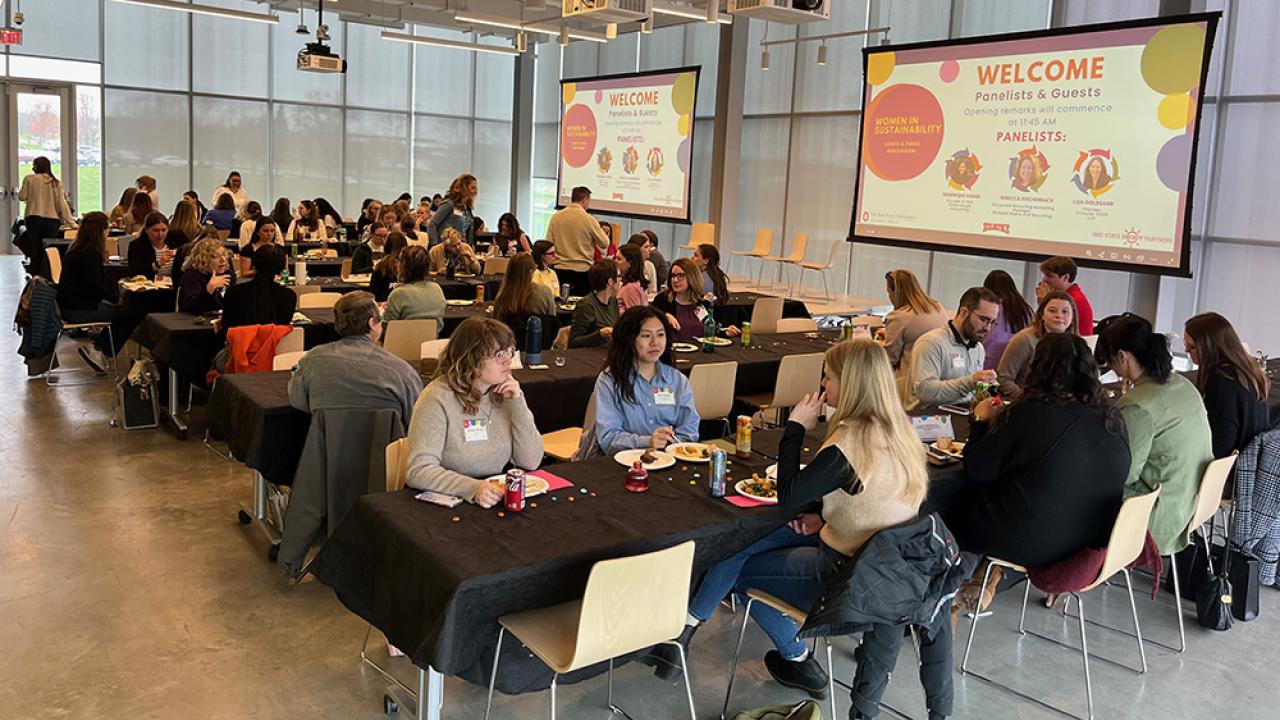
SI Co-Curricular and Community Initiatives Program Manager, Liz Quigley, organized this year’s Earth Month Luncheo and Networking Event at the Energy Advancement and Innovation Center, sponsored by SI foundational corporate sponsor Rumpke and the Ohio State Energy Partners (OSEP). SI Interns, Hifsah Ayub and Kaleigh Bayoumy, facilitated a panel of female leaders in different circular economy sectors.
After winning Ohio State’s 2020 President’s Prize Award, Dominique Hadad founded Green Scope Consulting, which provides sustainability consulting for central Ohio businesses and institutions such as restaurants and schools. Her work with local organizations revealed the overall mistrust of the waste management system, which is a key barrier to achieving a circular economy. In addition to her company, Hadad is a co-host of a podcast, Green Champions, that seeks to highlight strides in sustainability efforts and social impact.
Rebecca Reichenbach, Corporate Recycling Market Manager at Rumpke, underscored her passion about science and waste management, which led her to work for a company that has built the largest materials recovery facility (MERF) in Ohio. Always working in a male-dominated field, Reichenbach learned to find connections with her colleagues to establish close relationships. Fostering personal relationships with end users has also helped her professional projects and role as a woman in the waste management sector.
Lisa Goldsand, Founder of Circular Thrift LLC, empowers local communities to drive change and lead sustainable fashion efforts. Goldsand aims to help female consumers, who consume 68% of clothing imports, make more sustainable fashion decisions at a hyperlocal level. Goldsand stated that 60% to 80% of fashion workers are women of color, which emphasized the need for equity in the fashion industry. With over half of new clothing manufactured from polyester, a synthetic fiber made from petrochemicals, Goldsand encourages fashion industry partnerships with companies that know how to manage plastic waste, like Battelle and Advanced Drainage Systems (ADS).
Environmental History Documentaries
This Earth Month, the Department of History’s Environmental History Initiative offered a series of documentary screenings showcasing the impacts of climate change and environmental degradation around the world in different settings.
Chasing Coral captures the most severe coral bleaching event in recorded history, which occurred between 2014 and 2017. During these years, 75% of corals suffered or died from heat stress brought on by climate change. If current practices and trajectories continue, by 2034 there will be severe bleaching events annually and 90% of coral reefs could be lost by 2050.
Ohio State’s coral expert Andréa G. Grottoli, College of Arts and Sciences Distinguished Professor of Earth Sciences, provided commentary and context for the film screening attendees.
Anthropocene: The Human Epoch displays staggering visuals of intensive industries around the world, from residents sifting through an open-air landfill in Kenya to resell materials, to dangerous labor in the psychedelic potash mines in Russia’s Ural Mountains.
Before the showing of Anthropocene, SI Faculty Director, Elena Irwin, provided commentary about planetary boundaries, the global carbon cycle, and the Intergovernmental Panel on Climate Change (IPCC), providing context about the relationship between different industries, global warming, and climate change impacts.
Fashion Reimagined features the journey of a United Kingdom-based fashion designer to create a fashion brand from “field to finished garment,” ensuring a transparent supply chain and sustainably sourced fibers. The film focuses on sourcing wool, working with vendors around the world, and exposing the dirty truths about fashion’s impact on humans and the environment. Lisa Goldsand, panelist from the Women in Sustainability event, returned to the Columbus campus to provide commentary about the film based on her experience in the fast fashion industry.
Earth Day Festival
In the South Oval, Earth Day Festival attendees shopped second-hand at vintage vendors and supported small food and jewelry businesses. Student organizations, including the Sierra Club, Know Food Waste, Students for Sustainable Fashion, and more tabled to share their organizations’ missions and celebrate Earth Day.
Organized by Ohio State’s student chapters of the American Conservation Coalition and the Sierra Club, in addition to the local vendors and student organizations, the festival featured live music and a panel discussion with Lonnie Thompson, Distinguished University Professor in the School of Earth Sciences and a Research Scientist in the Byrd Polar Research Center, and Daniel Katz, founder of the Rainforest Alliance.
Lost Waters & Earth Day Parade
On April 22, attendees from the Ohio State and Columbus community marched to celebrate Earth Day, bringing awareness and appreciation for environmental protection. The parade started on the South Oval behind Hale Hall and followed the path of Old Neil Run, an historic stream that used to run through the South Oval and Mirror Lake.
Led by the Department of Art’s Living Art and Ecology Lab, attendees were able to visualize Old Neil Run through the lab’s virtual reality and story trail project titled Lost Waters. This unique opportunity showcased what Old Neil Run looked like over 100 years ago, helping attendees learn about the ecological history of this portion of the Columbus campus.
Environmental Professionals Network: Farm to Fashion
Every month of the academic year, the School of Environment and Natural Resources’ Environmental Professionals Network (EPN) hosts a seminar session that focuses on a different environmental theme or challenge. Every year, EPN also hosts a Signature Earth Day Event that explores a topic from multiple perspectives.
This year’s EPN Signature Earth Day Event, “Farm to Fashion: Natural fiber footprints and futures,” examined the journey of natural fibers from harvest to our garments. Speakers representing academic, agricultural, corporate, and entrepreneurial backgrounds in fiber production, told the sustainability stories of wool, cotton, hemp, and flax and how they can be incorporated into fashion today.
Speakers underscored that leaders in all stages of the supply chain, from agricultural production, to designers, to consumers must make sustainable decisions. Implementing regenerative agricultural practices, steering consumers towards sustainably sourced fashion items, and sourcing fibers from local farms do not even scratch the surface of necessary action. However, the speakers were optimistic about fostering transparent and local supply chains to reduce the human and environmental impact of fashion.